Quick answer
Asiatic black bears live in Gifu and Nagano, including the wider forested region around the Nakasendo. Check official sightings on the morning of your walk, avoid dawn and dusk, travel with someone where possible, and make your presence known. If you see a bear, don’t run; keep it in sight and back away slowly.
If you’re walking through forested or mountain areas around Nakatsugawa and the Nakasendo Trail, bear awareness is part of preparing for the journey.
But a sentence such as “Asiatic black bears live on Honshu and Shikoku” may not mean much if you don’t already have a map of Japan in your head.
Japan has two bear species. Brown bears live in Hokkaido. Asiatic black bears live on Honshu and in parts of Shikoku. Gifu Prefecture — where you’ll find Nakatsugawa, Magome and the Gifu side of the trail — is in the middle of Honshu. The bear species to be aware of here is the Asiatic black bear, known in Japanese as the tsukinowaguma.
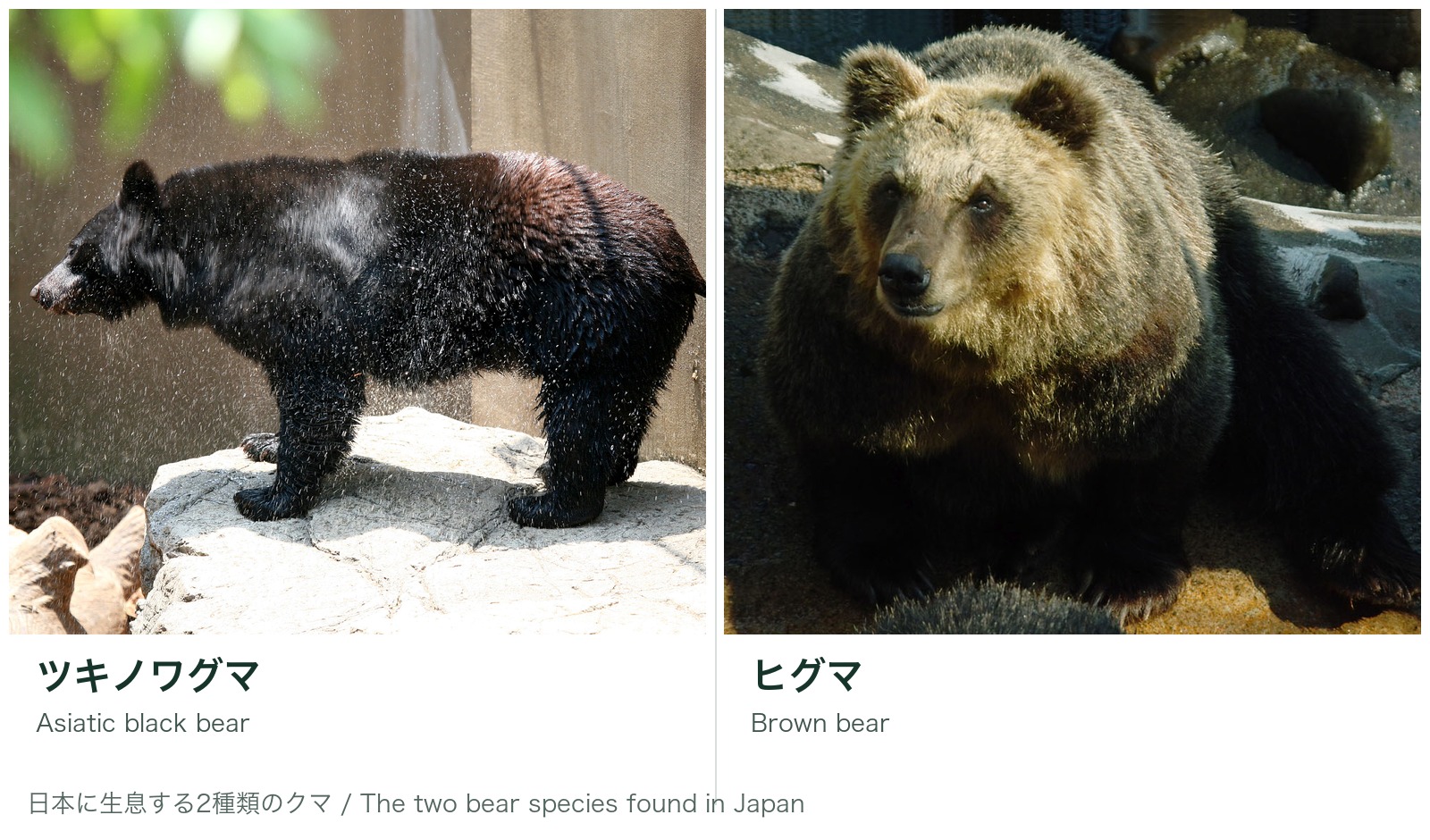
Left: Asiatic black bear. Right: brown bear. Neither photograph was taken in Nakatsugawa.
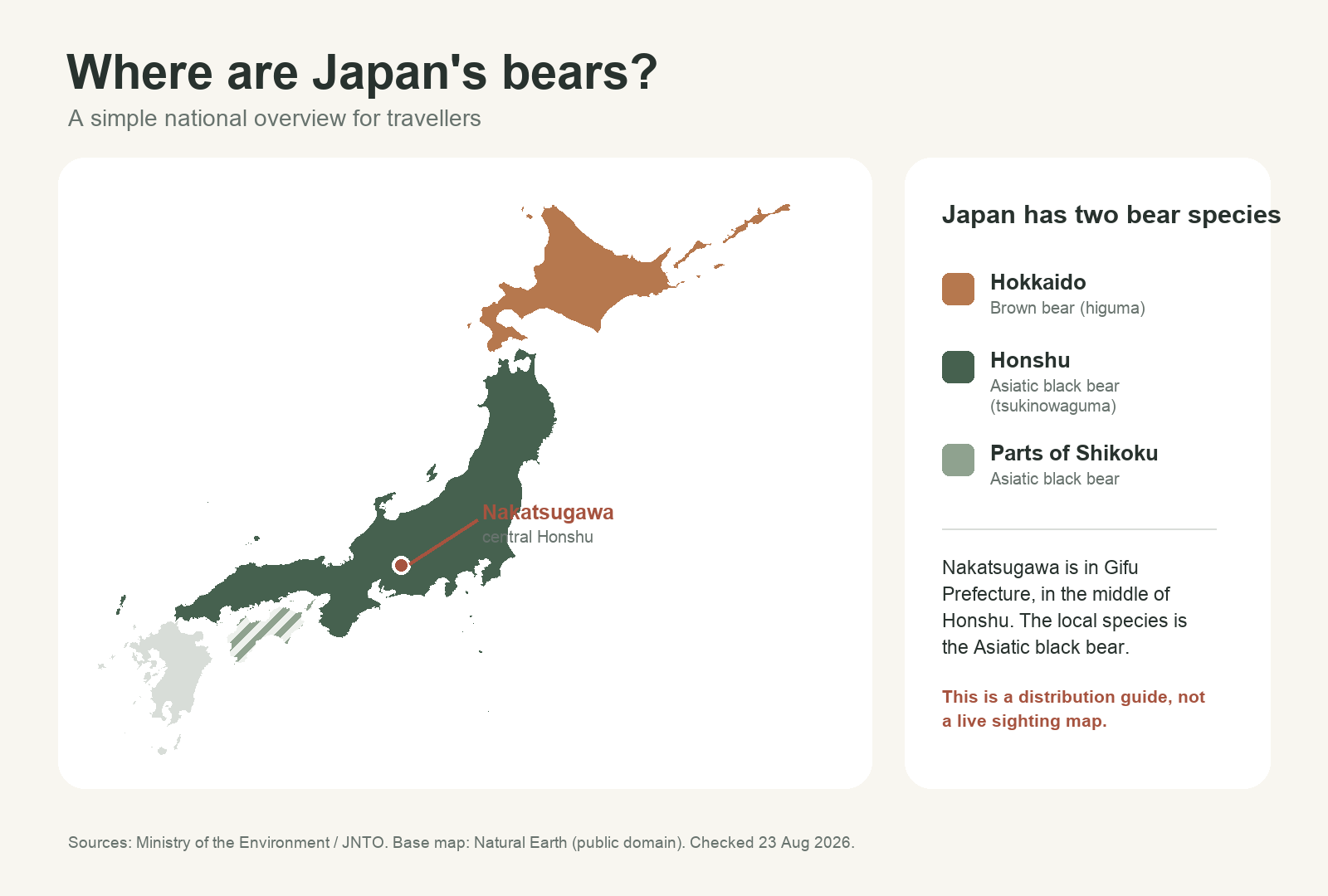
This is a broad guide to the distribution of Japan’s two bear species. It is not a live sighting map.
Asiatic black bears generally try to avoid people. However, a sudden encounter in an area with poor visibility, or an encounter near a cub, can become dangerous.
The aim isn’t to make the trail sound more dangerous than it is. It’s to understand the conditions, check current information on the day of your walk and reduce the chance of an encounter.
Official information to check on the day you walk
Bear sightings and alerts change. Check again on the morning of your walk, not only when you first plan the trip.
Gifu Prefecture and the Nakatsugawa side
The Gifu Prefecture page links to the official Gifu Bear Map, where you can check reported dates and locations.
Nagano Prefecture and the Tsumago side
- Nagano Prefecture: Asiatic Black Bear Information Map
- Official Tsumago website: Walking Information
- Official Tsumago website: Bear and Water-Safety Notice
The official Tsumago website advises people walking between Tsumago and Magome to ask the tourist information offices or tourism associations for current information before setting out.
Last checked: 31 August 2026
At the time of checking, Gifu Prefecture had an Asiatic black bear alert in effect. The official Tsumago website also stated that bears had been sighted in Nagiso Town during 2026. Alerts and recent reports can change, so use the links above for the latest information.
Are there bears on the Magome–Tsumago trail?
Asiatic black bears live in both Gifu and Nagano. Official records include sightings in the Tsumago and Otsumago districts, but the public data doesn’t show whether either sighting was on the Nakasendo Trail itself.
The classic Nakasendo walk from Magome to Tsumago passes through villages, forest, a mountain pass and areas close to running water. The conditions aren’t the same all the way along.
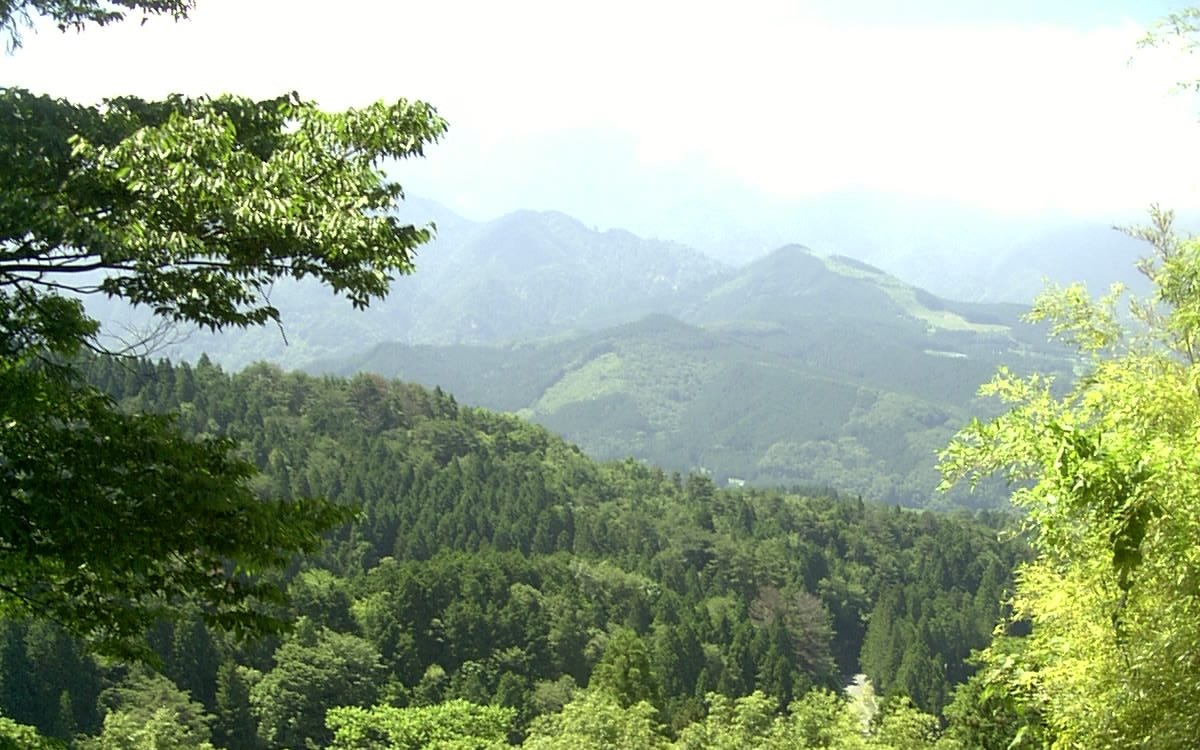
Mountain and forest scenery viewed from the hill above Magome.
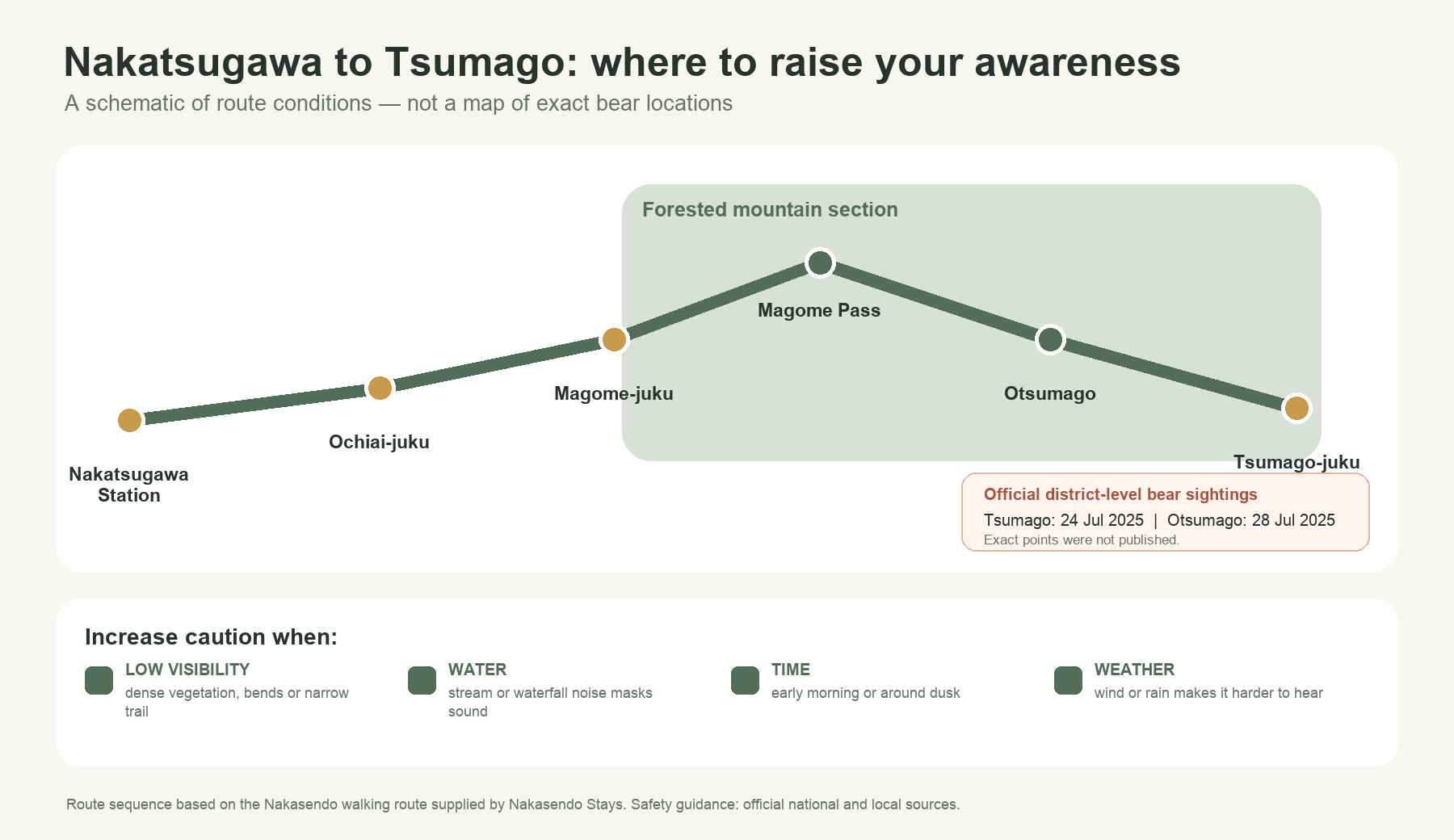
This diagram explains the order of the route and the conditions that call for greater awareness. It is not to scale, and it doesn’t show the current location of a bear or label any place as a “danger point”.
Nagano Prefecture’s official sighting list for July 2025 includes these two district-level records:
- 24 July 2025: one bear reported in the Tsumago area of Azuma, Nagiso Town
- 28 July 2025: one bear reported in the Otsumago area of Azuma, Nagiso Town
These records identify the district, not the exact point, and don’t show whether the bear was on the old Nakasendo itself. They should not be treated as exact sightings on the trail.
Nagano Prefecture’s 2026 monthly lists also include multiple sightings in Nagiso Town, but the public tables don’t identify detailed locations. Check the current Nagano map and ask the tourist information office on the day you walk.
Where can you rent a bear bell in Magome or Tsumago?
The official Tsumago website lists bear-bell rental at both Magome Tourist Information Center and Tsumago Tourist Information Center. Terms can change, so check the official page before your visit.
What kind of bears live around Nakatsugawa?
Japan’s Ministry of the Environment describes the Asiatic black bear as a large forest-dwelling mammal. Its crescent-shaped chest marking and temperament vary from one bear to another.
Asiatic black bears are omnivores. Their diet centres on grasses, tree nuts and fruit, and also includes insects. What they eat and the elevations they use change with the season.
Activity varies by region and climate. Bears are generally active from around March to November and hibernate from around December to February. Warmer winters and local conditions can shift this timing, so don’t assume that winter always means there is no activity.
Gifu Prefecture states that Asiatic black bears live across most of the prefecture. A lack of reported sightings doesn’t prove that bears aren’t present.
How to avoid a bear encounter on the Nakasendo
1. Avoid low-traffic areas at dawn and dusk
Nakatsugawa City advises people to avoid low-traffic forests and riversides in the early morning and around dusk, when bears are more active.
Plan to finish while it is still light and leave enough time for delays.
2. Don’t walk alone, and make your presence known
Gifu Prefecture and Nakatsugawa City recommend travelling with at least one other person and using sound to let bears know you’re there. A bear bell or radio can help. The national guidance also suggests using your voice or clapping your hands.
Take extra care on bends with poor visibility, near streams or waterfalls, or in strong wind and rain, when a bear may not hear you clearly. A bell isn’t a substitute for checking recent sightings, choosing an appropriate time and paying attention to the conditions around you.
3. Turn back if you find fresh tracks or droppings
Gifu Prefecture advises leaving immediately if you find fresh bear tracks or droppings.
Don’t move closer to take a photograph or continue ahead to investigate.
4. Keep food and rubbish under control
Never leave food, bags or rubbish unattended. Keep them sealed where possible, and carry all food waste and rubbish out with you.
A bear that learns to associate people with food may return to places used by people. Managing food and rubbish helps protect visitors, the community and the distance between people and wildlife.
5. Learn how bear spray works before carrying it
The national guidance recommends checking in advance where bear spray can be bought or rented and learning how to use it.
Bear spray can’t be carried onto an aircraft or placed in checked baggage. If you’re considering it, find out where it can be obtained after you arrive in Japan.
What to do if you see a bear
If the bear hasn’t noticed you
- Don’t approach it. Leave the area quietly.
- Don’t move closer to take a photograph.
- Never approach a cub. Its mother may be nearby.
If the bear has noticed you
- Don’t shout.
- Don’t turn your back and run.
- Don’t throw bags, stones or other objects.
- Keep the bear in sight and back away slowly.
- Don’t force your way past it. Keep your distance and wait for it to leave.
Startling or agitating a bear can trigger an attack.
If an attack appears imminent
Japan’s Ministry of the Environment advises lying face down and protecting your neck, face and abdomen. If you have bear spray and have already learned how to use it, use it as directed.
Reporting a sighting in Nakatsugawa
Once you’re in a safe place, report the sighting to Nakatsugawa City or the police.
- If there is an immediate danger, call the police on 110.
- If someone is injured, call fire and ambulance services on 119.
Nakatsugawa City uses reports to patrol the area and issue local warnings. Don’t try to drive the bear away yourself or return for another look.
Checklist before walking the Nakasendo
- Check the latest Gifu, Nakatsugawa, Nagano and Tsumago information.
- Plan to finish during daylight.
- Travel with at least one other person where possible.
- Carry a bell or another way to make your presence known.
- Keep food and rubbish sealed and take everything with you.
- Turn back if you find fresh tracks or droppings.
- Save the emergency numbers 110 and 119.
- Leave room to change or cancel the plan.
This guide covers basic preparation for walking around Nakatsugawa and between Magome and Tsumago. Conditions vary by location, season, weather and recent bear activity. Always check the latest official information before you set out.
Use Nakatsugawa as your base

Nakasendo Stays is a directly operated accommodation brand for exploring the Nakasendo Trail and surrounding areas. Rates vary by date, number of guests, room and availability.
Planning the Magome–Tsumago walk? Compare Nakasendo Stays properties in Nakatsugawa, then check current availability for your dates.
For train, bus and other arrival options, see our Access page.
If you have a general question before booking or aren’t sure which property fits your route, contact Nakasendo Stays through our Contact page.
Written by Takuji Funahashi
Official information
- Ministry of the Environment, What to Know About Bears Before Visiting a National Park
- Ministry of the Environment and JNTO, Before You Go: What to Know About Bears in Japan’s National Parks
- Gifu Prefecture, Bears Living in Gifu Prefecture
- Nakatsugawa City, Current Bear Notice
- Nakatsugawa City, What to Do After a Bear Sighting
- Nagano Prefecture, Asiatic Black Bear Information Map
- Nagano Prefecture, July 2025 Asiatic Black Bear Sighting List
- Official Tsumago website, Walking Information
- Official Tsumago website, Bear and Water-Safety Notice
- JNTO, Japan Visitor Hotline